
What Is an Industrial Coding and Marking Machine? A Primer on Inkjet and Laser Systems
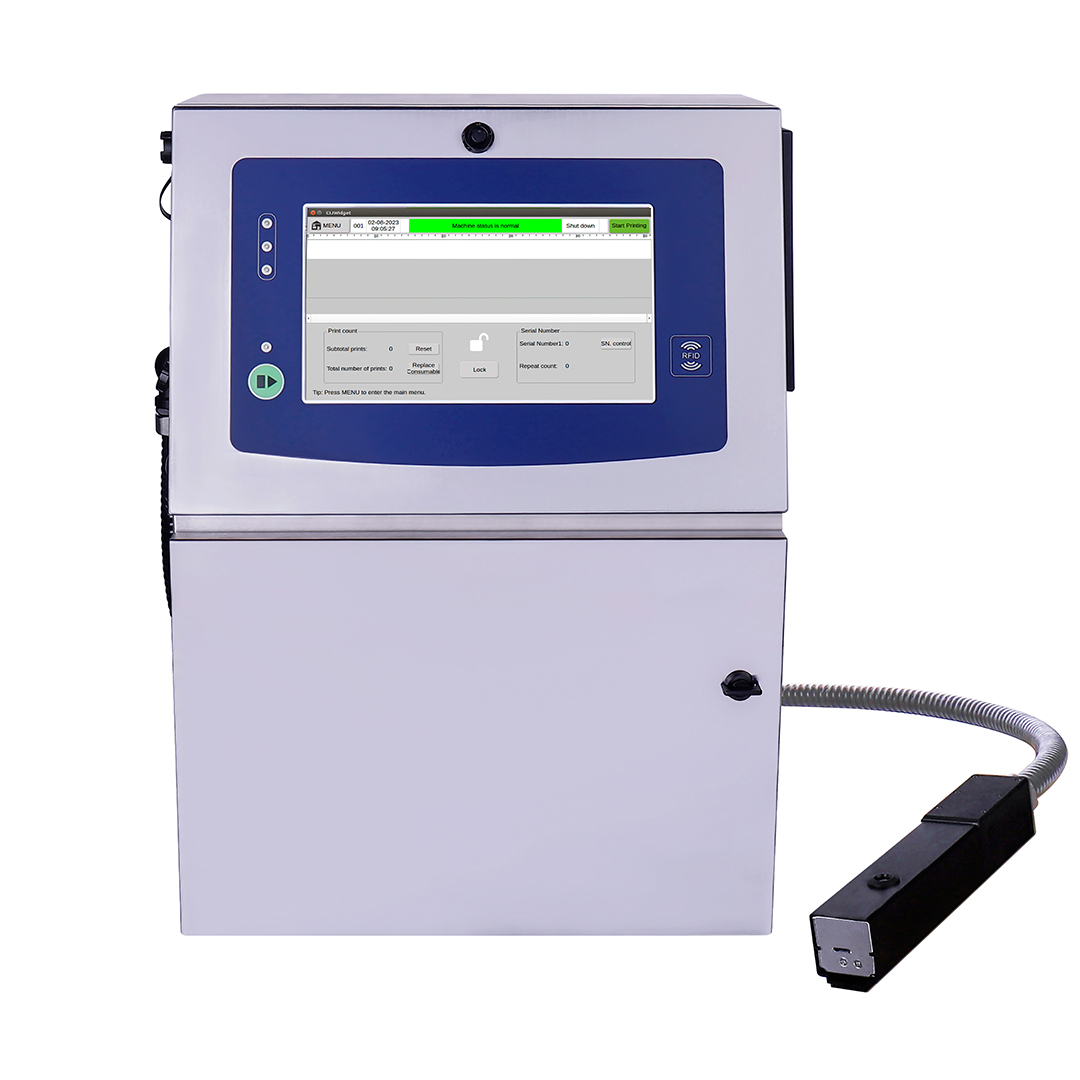
A continuous inkjet printer is one of the systems grouped under the term industrial coding and marking equipment.
An industrial coding and marking machine applies variable information — production dates, batch and lot codes, serial numbers, barcodes and 2D codes — onto products, packaging or components as they move along a production line. The label covers at least four inkjet families and three mainstream laser types, and they are not interchangeable: each creates the mark in a different way, sits at a different distance from the product, runs at a different speed and accepts a different list of substrates.
This primer is written for buyers specifying coding equipment for the first time. It explains what each technology is, what the common datasheet terms mean — dpi, wavelength, marking range, throw distance — and how to match a system to a production scenario.
What Counts as an Industrial Coding and Marking Machine
An industrial coding and marking machine is production-line equipment that places a human-readable or machine-readable mark on a unit of product, at line speed, without stopping the line. The mark may be a date, a batch code, a serial number, a barcode, a QR or DataMatrix code, a logo, or a combination of these.
The vocabulary is where first-time buyers lose time. A high speed coding machine for packaging lines, a CIJ coding printer, a laser marking machine and a thermal transfer overprinter can all appear on the same shortlist even though only some of them can physically do the job in front of the buyer. Three gaps cause most specification errors:
- Printing and lasering are treated as one process. Inkjet systems deposit a consumable — ink or ribbon — onto the surface. Lasers alter the material itself, producing a mark that does not rub off, survives oil and heat, and consumes no ink.
- One number is used to judge quality. Resolution in dpi is usually the first specification a buyer reads, but it says nothing about whether the head can print at the required distance, height or line speed.
- The scenario is defined last. Most failed projects are substrate or speed problems. A code that is crisp on a carton may be unreadable on a curved cable, and a platform rated at 600 dpi may run at half the speed of the same platform in 300 dpi mode.
Where the Category Stands in 2026
Coding equipment is bought for regulation and traceability as much as for branding. ID Technology describes the category as labeling, coding and marking solutions for diverse substrates in industrial and manufacturing environments, with traceability and quality control as the core purpose — close to how most buyers experience it, because the code is the physical evidence that a unit was produced, inspected and tracked.
Commercial research from Fortune Business Insights put the global coding and marking equipment market at USD 7.51 billion in 2025, and the same source places the inkjet family — CIJ, TIJ and PIJ combined — at 40.1% of the technology segment. Inkjet is therefore the default starting point for most packaging and industrial lines, with laser taking the applications where permanence matters more than consumable cost.
One regulatory date matters for anyone buying in 2026. Under the GS1 Digital Link standard, Sunrise 2027 sets a 31 December 2027 deadline for the retail transition from 1D barcodes to 2D codes. A system purchased today that cannot print a QR or DataMatrix code may need replacing well inside its service life, so 2D capability is a specification item rather than a future upgrade.
Suppliers in this space range from global OEMs to mid-size manufacturers. DOCOD Precision Group Co., Ltd. is an industrial coding, marking and inspection equipment manufacturer based in Guangzhou, China, founded in 2008, with 407 employees and more than 140 R&D staff, an annual output of about 5,000 units and exports representing roughly 50% of sales. Its portfolio — at www.docod-group.com — covers continuous inkjet printers, thermal inkjet printers, handheld inkjet coders, piezo inkjet systems, drop-on-demand large-character printers, thermal transfer overprinters, laser marking machines, inline vision inspection systems, consumables, spare parts and traceability solutions. That breadth makes the range a useful reference set for comparing how the technologies differ.
Continuous Inkjet (CIJ): Non-Contact Coding at High Speed
A CIJ coding printer breaks a pressurised ink stream into a continuous sequence of droplets and deflects only the droplets needed to form the character onto the moving product. Because the printhead never touches the surface and prints from a standoff distance, CIJ suits curved, irregular or continuously moving products — cable, pipe, extruded profiles and filled containers.
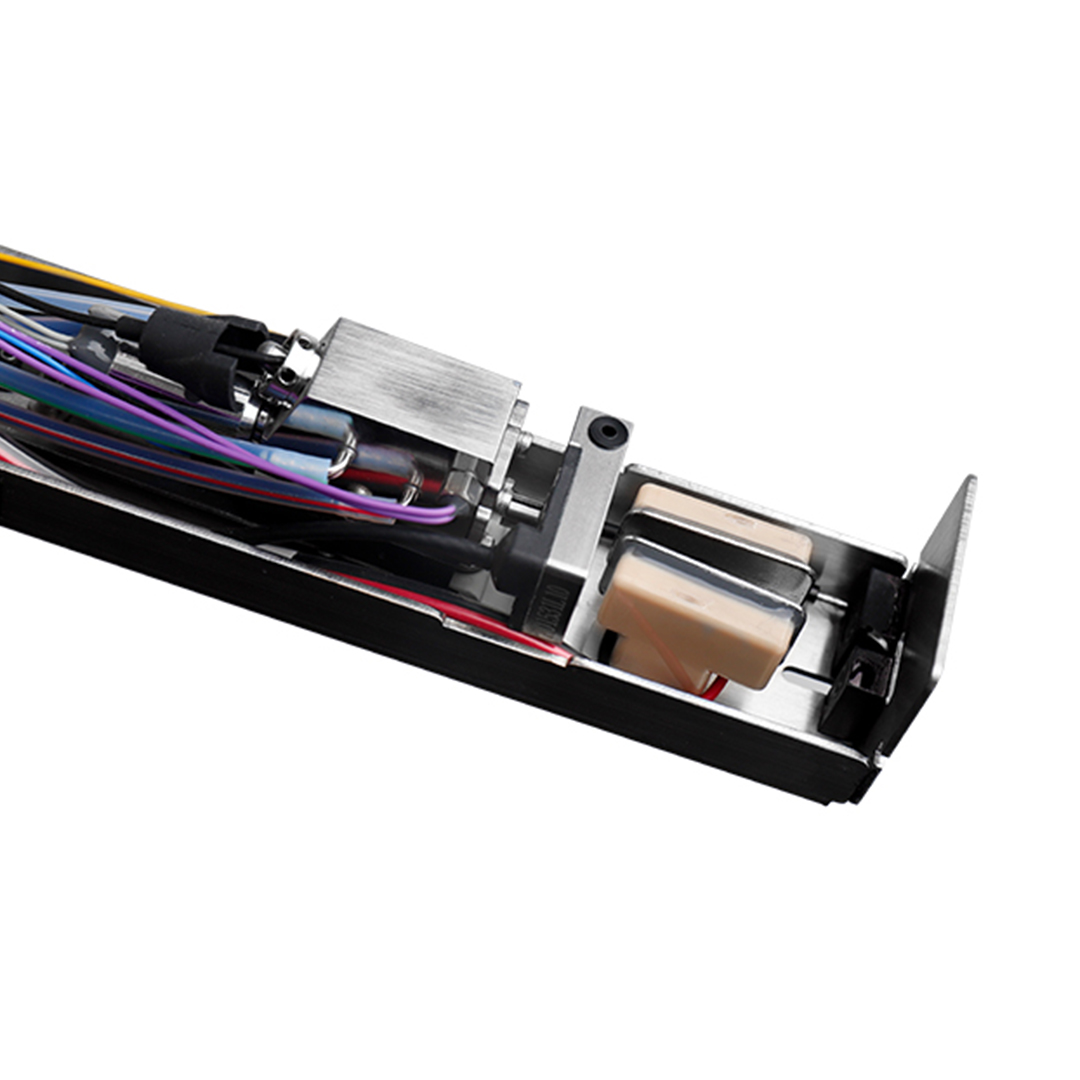
Inside a continuous inkjet printhead: the nozzle assembly that forms and deflects ink droplets.
Specifications that determine fit:
- Print distance and height. The DOCOD M2000 Series prints at 2–16 mm distance with a 3–30 mm print height and up to 4 lines. The S300plus Series offers 2–16 mm distance with a 3–30 mm height and up to 5 lines. The V2000 Series works at 3–30 mm distance with a 2–16 mm height, and the S1000 Series at 3–20 mm distance with a 2–16 mm height.
- Speed. The M2000 Series reaches up to 528 m/min, the S300plus Series up to 384 m/min (5 dots in one line, 0.5 mm dot spacing) and the V2000 Series up to 334 m/min. The S1000 Series is positioned for higher-speed packaging, quoting up to 720 m/min with a 60u nozzle and up to 960 m/min with a 50u nozzle at 0.5 mm pitch.
- Environment. M2000, S300plus and V2000 use SUS 304 stainless steel housings rated IP65; the S1000 is rated IP55.
- Certification. M2000 and V2000 carry CE and RoHS; S1000 and S300plus carry CE, RoHS and BIS.
- Data. Text, dates, shift codes, serial numbers, dynamic barcodes and QR codes, and database-driven serial data, with USB, RS232 and network ports for MES connection on supported models.
Plan for the limits as well: CIJ marks small characters measured in millimetres, uses solvent or dye inks that need appropriate handling and ventilation, and is not a high-resolution graphics printer.
Thermal Inkjet (TIJ): Cartridge Resolution and Simple Mounting
A TIJ coding printer fires ink from a cartridge using a thermal element, so the printhead and the ink supply are one consumable item. That structure makes TIJ the easiest inkjet technology to mount and the usual choice for carton, label, pouch and component coding where a clean, high-resolution code is needed at moderate to high speed.
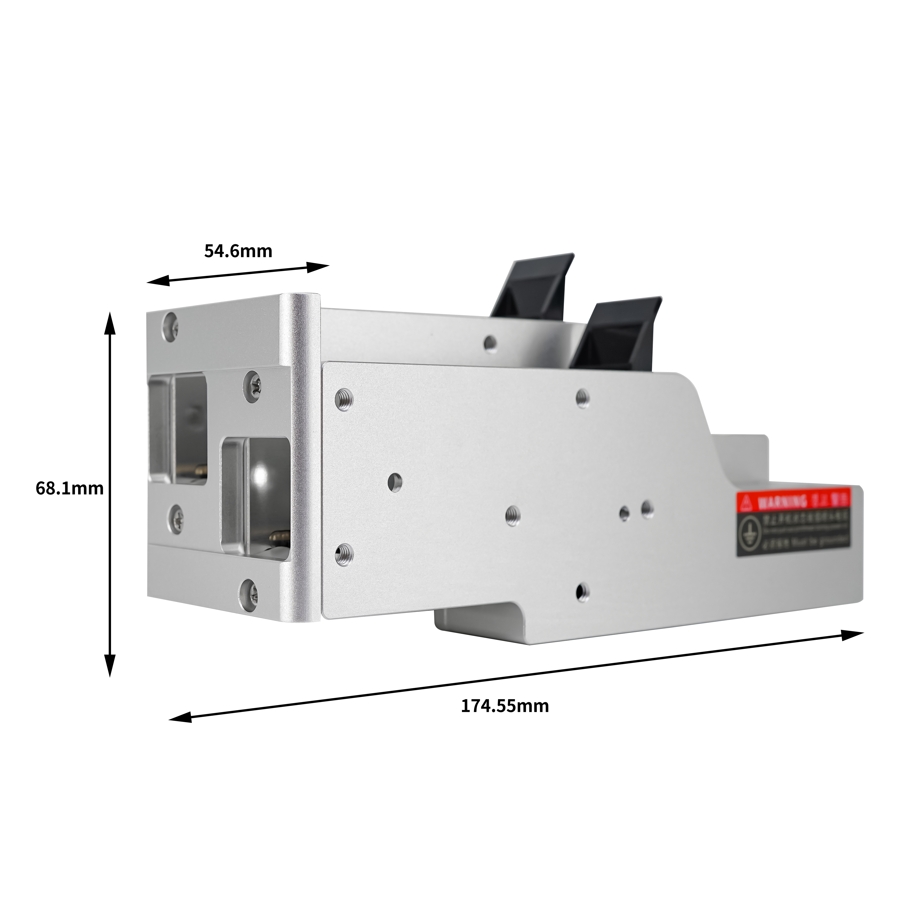
A half-inch dual-head thermal inkjet printhead module: resolution comes from the cartridge, while coverage comes from how many heads are mounted.
- Resolution. The T260E prints up to 300 × 300 DPI, the T220E up to 600 × 600 DPI, and the TX1 up to 300 × 300 DPI. The DOCOD 3BK702 half-inch black solvent cartridge is rated up to 600 dpi with a recommended 300 × 300 printing resolution, 300 nozzles, 42 ml of solvent ink and a six-month best-use period.
- Print height. 1–12.7 mm with one head and 1–25.4 mm with two heads on the T220E and T260E. The TX1 supports up to eight printheads for a combined height of 1–101.6 mm.
- Speed. Up to 406 m/min on the TX1 and T220E, and up to 60 m/min on the T260E.
- Substrates listed across the family. Cartons, plastics, metals, plates, pipes, stone, wires and cables, electronic components, auto parts, and chemical, pharmaceutical, food and gift packaging.
The trade-off is distance and consumables. The TIJ head integrated into the XF30 vertical rewinding machine prints at 1–2 mm, so the product must pass close to the head on a stable path. The cartridge is consumed, so cost per code depends on ink volume and coverage rather than equipment price alone, and ink type must match the substrate — water-based, oil-based, weak solvent or solvent.
Piezo Inkjet (PIJ): High Resolution on Porous Surfaces
A piezo system deforms the nozzle electrically instead of heating it, which allows a wider ink range and a larger nozzle array. The DOCOD P2000 uses I1600 series nozzles in a single- or dual-head configuration, prints at 300 dpi or 600 dpi, covers up to 33.8 mm with a single head, and runs at 190 m/min in 300 dpi mode or 95 m/min in 600 dpi mode. Print distance is 0–5 mm with 2–3 mm recommended, the ink system is a negative-pressure continuous feed, and the unit is CE-marked.
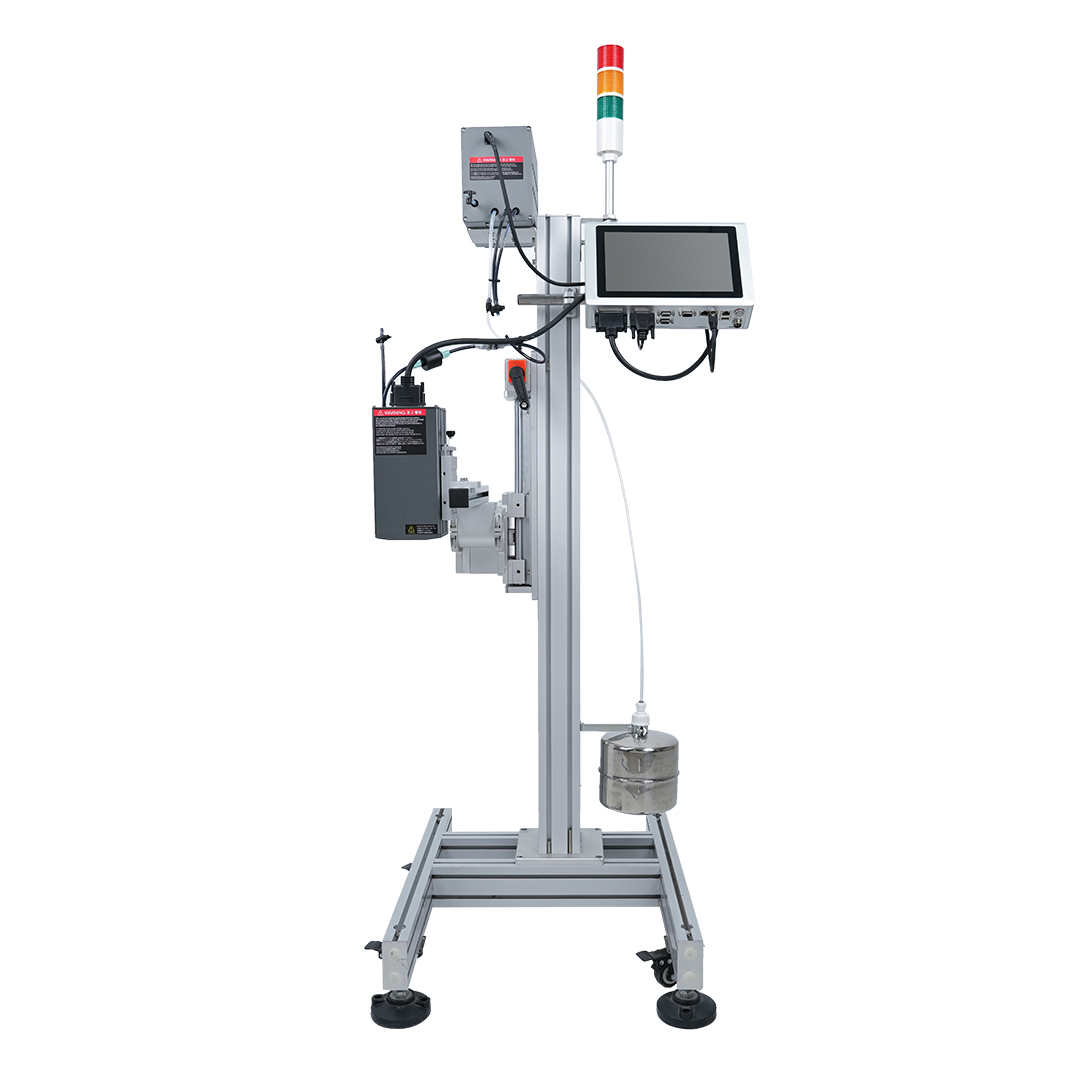
A high-resolution piezo inkjet printer: 300 dpi or 600 dpi output for cartons, corrugated board and coated paper.
The relationship that matters commercially is resolution against throughput: doubling resolution on the same platform roughly halves line speed. Cartons, corrugated board, coated paper, label paper and packaging gift boxes are the natural application area, where large legible text and readable barcodes matter more than maximum line speed.
Laser Marking: Fiber, UV and CO2 Systems
A laser marking machine does not print; it alters the material surface, so the code survives abrasion, oil, water and heat. The trade-off is a shorter substrate list and a higher capital cost than an entry-level inkjet printer.
Fiber laser, 1,064 nm — the metal standard
The DOCOD Venus1 fiber series is available at 20W, 30W, 50W and 100W with air cooling, a standard 110 × 110 mm marking area with 50–300 mm optional, IP43 protection, character heights from 0.6 mm, and a quoted laser life of up to 100,000 hours. Typical applications include metal and coating work, medical devices, automotive parts, industrial bearings, aerospace components, PCB boards, metal caps, aluminium products, stainless steel, pipes and cables.
UV laser, 355 nm — low-heat marking for plastics and packaging
Ultraviolet wavelength is absorbed rather than burned into the surface, which is why it is used on plastics, films and heat-sensitive packaging. The Venus1 UV marker is offered at 5W, 10W and 15W with air or water cooling, a standard 110 × 110 mm area with 70–300 mm optional, rated IP43 or IP54. The L3000 Series 5W UV marking machine offers a standard 70 × 70 mm marking range with 70–300 mm optional, a minimum line width of 0.02 mm, 0.01 mm positioning accuracy, and a quoted 29 ms to mark a date code of 20 mm character width and 2.8 mm height on PP film. Applications include soft film packaging, pharmaceutical and food packaging, PVC pipe, flexible circuit boards and high-end electronics. Quoted UV laser life is 2–3 years.

A 355 nm UV laser marker: low-heat marking for films, plastics and heat-sensitive packaging.
CO2 laser, 10.6 μm — for non-metals
The Venus1 CO2 series is available at 30W and 60W with air or water cooling, a standard 110 × 110 mm area with 70–300 mm optional, IP43 or IP54 protection and a quoted 20,000-hour laser life. It is specified for non-metal processing: plastics, packaging and printing, rubber, wood, acrylic, glass, cable marking and kraft board.
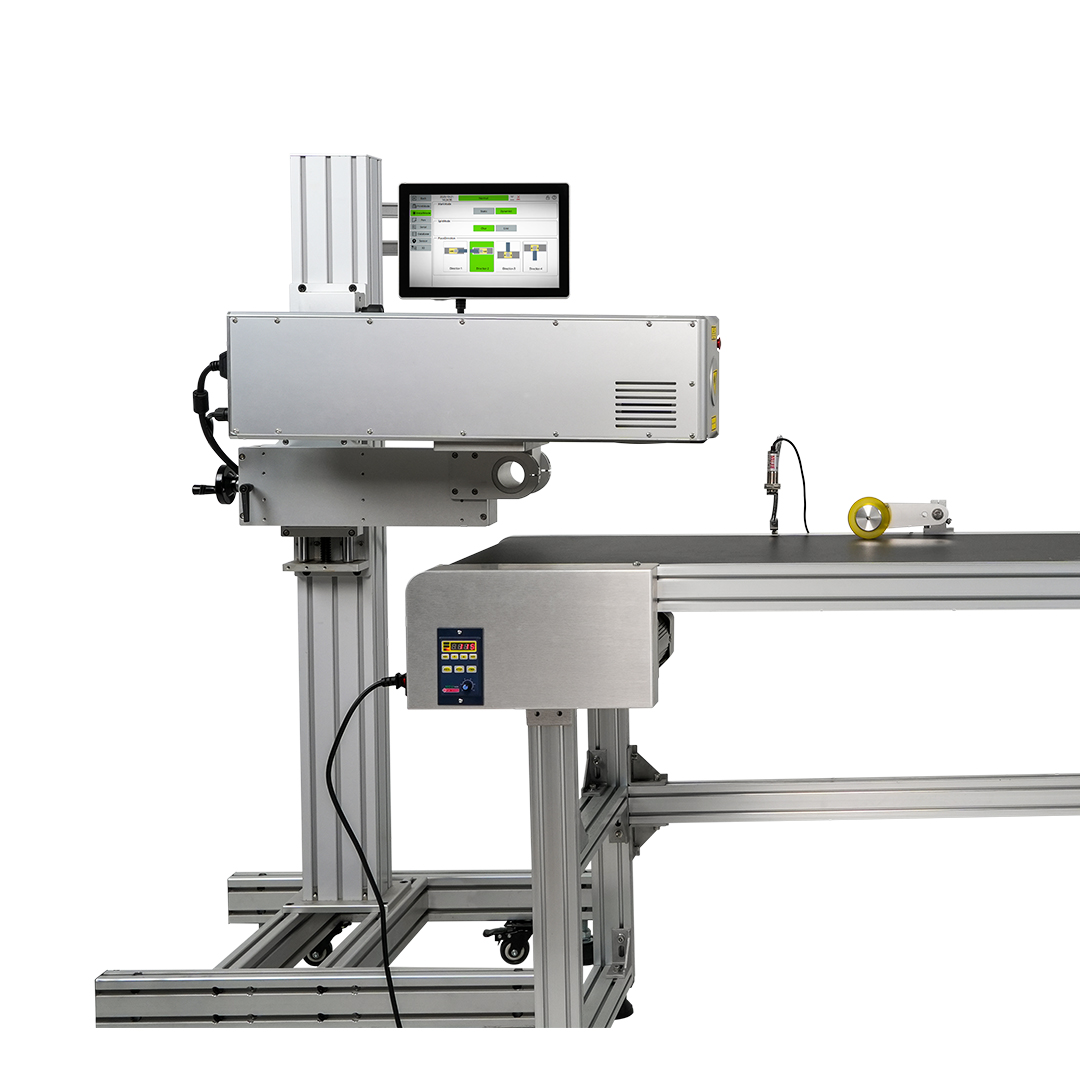
A CO2 laser marking machine with a 10.6 μm wavelength for non-metal substrates.
Two limits deserve attention before a laser is shortlisted. The substrate must absorb the wavelength — fiber lasers will not mark most clear plastics or uncoated non-metals, while UV and CO2 systems are not suitable for every metal. And marking speed is content-dependent: character size, density and material determine cycle time, so cycle time should be validated at the real line speed rather than estimated from a catalogue figure.
Printers, Inspection and Line Hardware Around the Coder
A coding system is rarely a single box. Traceability workflows typically combine the coder with code inspection and material handling. The DOCOD portfolio includes inline vision inspection systems for code verification, the XC20 mini conveyor — a 150 mm PVC belt running at 5–12 m/min, suitable for inkjet, inspection and weighing stations on fine products — and the XF30 vertical rewinding machine, which pairs a T210E thermal inkjet head with label rewinding at 0–45 m/min for short-run label rework.
Two adjacent technologies complete the picture. A thermal transfer overprinter such as the R3000 applies a heated ribbon to flexible film, offering a 32 × 75 mm or 53 × 70 mm print area at 300 dpi, ribbon widths of 24, 33, 35 and 55 mm, GS1 DataMatrix and dynamic QR printing, and quoted maximum print speeds of 200–350 mm/s with up to 800 mm/s referenced for the platform. Drop-on-demand large-character inkjet printers extend the same idea to large characters on cases and cartons.
Reading a Coding Datasheet: The Terms That Decide the Project
- dpi (dots per inch). Resolution. 300 × 300 DPI is adequate for most date and batch codes; 600 × 600 DPI suits small 2D codes and fine text. On the P2000 the choice is linked to speed: 190 m/min at 300 dpi, 95 m/min at 600 dpi.
- Wavelength. 355 nm (UV — low heat, plastics and films), 1,064 nm (fiber — metals), 10.6 μm (CO2 — non-metals, with 10.2 μm and 9.3 μm options).
- Marking range or marking area. The field a laser can address. The L3000 UV machine marks a standard 70 × 70 mm area with 70–300 mm optional; the Venus1 UV and CO2 series and the fiber series mark 110 × 110 mm standard, with 70–300 mm or 50–300 mm optional.
- Print height. 3–30 mm on M2000 and S300plus; 1–12.7 mm to 1–101.6 mm on TIJ depending on the number of heads; up to 33.8 mm with a single PIJ head.
- Throw distance. How far the head can sit from the product: 2–16 mm on most CIJ models, 0–5 mm on PIJ, and 1–2 mm on a TIJ head in a rewinding setup.
- Line speed. Always quoted with a resolution, a nozzle size and a dot pitch — compare like with like.
- IP rating. IP55 on the S1000, IP65 on M2000, S300plus and V2000, and IP43 or IP54 on laser systems.
- Certification. CE and RoHS appear on M2000 and V2000; CE, RoHS and BIS on S1000 and S300plus; CE on the P2000.
Comparing the Main Coding Technologies
| Technology | How the mark is created | Resolution | Coverage | Speed reference | Best-fit substrates |
|---|---|---|---|---|---|
| Continuous inkjet (CIJ) | Continuous ink droplets deflected onto the product | Small-character dot matrix | 3–30 mm print height (M2000, S300plus); 2–16 mm (S1000, V2000) | Up to 528 m/min (M2000); 384 m/min (S300plus); 334 m/min (V2000); up to 720–960 m/min (S1000) | Carton, plastic, metal, cable, pipe, glass, sheet material, components |
| Thermal inkjet (TIJ) | Thermal element ejects ink from a cartridge | Up to 300 × 300 DPI or 600 × 600 DPI | 1–12.7 mm with one head; 1–25.4 mm with two; up to 101.6 mm on TX1 | Up to 406 m/min (TX1, T220E); up to 60 m/min (T260E) | Cartons, plastics, metals, pipes, cables, electronics, packaging |
| Piezo inkjet (PIJ) | Electrical deformation of the nozzle | 300 dpi or 600 dpi | Up to 33.8 mm with a single head | 190 m/min at 300 dpi; 95 m/min at 600 dpi | Cartons, corrugated board, coated paper, label paper, gift boxes |
| Thermal transfer overprinter (TTO) | Heated ribbon transfers ink to flexible film | 300 dpi | 32 × 75 mm or 53 × 70 mm print area | 200–350 mm/s quoted, up to 800 mm/s | Flexible film, stick packs, sealed bags, metallised and decorative labels |
| Fiber laser (1,064 nm) | Laser alters the material surface | Character height from 0.6 mm | Standard 110 × 110 mm; 50–300 mm optional | Content- and substrate-dependent | Metals and coatings, PCB, bearings, automotive and aerospace parts |
| UV laser (355 nm) | Low-heat photochemical marking | Character height from 0.6 mm; 0.02 mm minimum line width (L3000) | Standard 70 × 70 mm (L3000) or 110 × 110 mm (Venus1 UV); 70–300 mm optional | Content-dependent; example 29 ms for a date code on PP film | Films, plastics, pharmaceutical and food packaging, PCB, PVC pipe |
| CO2 laser (10.6 μm) | Thermal marking of non-metal surfaces | Character height from 0.6 mm | Standard 110 × 110 mm; 70–300 mm optional | Content-dependent | Plastics, packaging, rubber, wood, glass, cable, acrylic, kraft board |
Table values are drawn from published DOCOD product specifications. Laser marking speed is always content-dependent and should be validated on the actual substrate.
Step-by-Step: Matching a System to a Production Scenario
Step 1 — Define the code before the machine. Decide whether the mark is regulatory (dates, lot codes, UDI, tax control), logistical (SSCC, barcode, serial number) or brand-related. Regulatory codes drive verification requirements; logistical codes drive 2D capability.
Step 2 — Identify the substrate and its geometry. Porous cartons and corrugated board suit PIJ, TIJ or large-character DOD. Flexible film usually points to TTO or a laser. Curved cable, pipe and extruded profiles suit non-contact CIJ. Metal parts and coated components are fiber laser territory, while plastics and heat-sensitive packaging point to UV laser.
Step 3 — Compare line speed against resolution. A 600 dpi PIJ setting runs at half the speed of 300 dpi on the same unit. High-speed CIJ exceeds 500 m/min but marks small characters. TIJ reaches 406 m/min at up to 600 × 600 dpi on the T220E.
Step 4 — Check the physical envelope. Print distance, head size and mounting hardware decide whether the head can be installed where the product actually passes, and how much vibration the mount must tolerate.
Step 5 — Confirm environment and compliance scope. Match the IP rating to washdown, dust and humidity, and confirm which certifications apply to the specific model rather than to the brand in general.
Step 6 — Validate on your own product. Sample printing verification and a function test before shipment are standard practice for standard equipment supply, and integration projects can include a sample run and video acceptance before delivery.
Use Cases: How Buyers Apply Each Technology
The same decision resolves differently by industry:
- Cable and wire. A US cable manufacturer runs meter marking on cable sheath across 6 lines with the M2000 Series CIJ printer, reporting clearer and more consistent codes over a two-year period.
- Pharmaceutical cartons. An Indian pharma packaging supplier prints QR and expiry codes on three cartoning lines with T220E dual-head TIJ printers, reporting improved code readability after 18 months.
- Cosmetics and personal care. A Polish cosmetics OEM marks lot codes on plastic bottles and caps on two lines using a UV laser, choosing the 355 nm process for permanent, high-contrast, low-heat marking.
- Metal components. A German electronics parts supplier marks metal connectors permanently at two workstations with a Venus1 fiber laser, selected for durable, readable marks on metal.
- Flexible film. An Indonesian snack manufacturer codes dates on two VFFS lines with the R3000 thermal transfer overprinter, reporting cleaner film coding output.
- Pipe extrusion. A Saudi plastic pipe producer applies specification and date marking on PVC pipe across two extrusion lines with a CO2 laser, using non-contact marking suited to non-metal materials.
- Contract packing. A Brazilian contract packer deployed TX1 TIJ printers across eight packing stations for batch and QR printing on shipping cartons, favouring a compact setup for limited space.
- Building materials and chemicals. In a UAE replacement project, large-character coding is integrated with bagging, extrusion or filling lines to print batch numbers, production dates, model information, brand marks, QR codes and logistics codes in dusty, hot, humid or rough-surface conditions.
- Tobacco packaging. In Turkey, serialized tobacco coding projects print batch codes, tax-control codes, DotCode and DataMatrix, QR codes and supply-chain traceability codes at high speed, integrated with pack handling and vision inspection.
Two shared patterns emerge. First, the substrate usually eliminates half the shortlist before price is discussed. Second, verification is becoming part of the specification: where codes are regulatory, buyers increasingly pair the coder with inline vision inspection, a reject unit and a PLC or MES connection so that unreadable codes never leave the line.
FAQ
What certifications should a first-time buyer verify on industrial coding equipment?
Check the certification scope of the specific model, not the brand. In the DOCOD range, the M2000 and V2000 continuous inkjet printers carry CE and RoHS; the S1000 and S300plus carry CE, RoHS and BIS; and the P2000 piezo inkjet printer is CE-marked. Ingress protection is a separate but related specification: IP65 on M2000, S300plus and V2000, IP55 on S1000, and IP43 or IP54 on laser systems. Buyers in regulated industries should also confirm that the selected model supports the code standard they need, such as GS1 DataMatrix, and pair it with inline code inspection where verification is required.
Can one machine print both 2D codes and plain date codes?
Yes, across all four coding families, but the configuration differs. CIJ printers print text, dates, serial numbers, dynamic barcodes and QR codes. TIJ printers print GS1 codes, dynamic traceability QR codes, serial numbers and dates. PIJ systems print dynamic barcode and QR content with database-driven data. Thermal transfer overprinters print GS1 DataMatrix and dynamic QR codes on flexible film, and laser systems support large barcode and 2D symbology sets including QRCODE, DATAMATRIX, MICROQR and PDF417. With the GS1 Digital Link Sunrise 2027 deadline of 31 December 2027 approaching, confirming 2D capability at the specification stage avoids a premature replacement.
Does higher resolution reduce line speed?
Often, yes. On the P2000 piezo inkjet printer, the same platform runs at 190 m/min in 300 dpi mode and 95 m/min in 600 dpi mode. TIJ behaves similarly across the family: the 600 × 600 DPI T220E and the 300 × 300 DPI T260E both print up to a 25.4 mm height with two heads, but the T220E is specified up to 406 m/min while the T260E is specified up to 60 m/min. Laser marking speed is not fixed at all — it depends on the substrate, the size of the marking content and its complexity, so cycle time must be tested on the real product.
Can we test the system on our own material before production?
Yes. Sample printing verification and a function test before shipment are part of standard equipment supply, and channel partners can request demo and sample validation as part of a cooperation review. For integrated projects, the workflow can include integration testing, a sample run and video acceptance before delivery. Sending actual product samples — cartons, film, cable, metal parts or bottles — is the fastest way to confirm code quality, contrast and read rate.
How long does delivery take, and what is the minimum order?
Standard equipment is typically delivered within 15 working days with a minimum order of one set. OEM branding support runs 15–25 working days (minimum one set), ODM functional customisation 20–30 working days (minimum one set per project), production line integration 20–35 working days (minimum one line), and spare parts and consumables ship within 15 working days with a minimum of one piece. Distributor and service partner programmes quote 15–30 days with a minimum of two units.
To move from a primer to a decision, send a sample of the material you need coded together with the code content you need to print, and the application team can confirm the technology, resolution and speed that fit your line. The DOCOD corporate brochure is available here.
Conclusion
An industrial coding and marking machine is defined less by its brand than by three facts about the job: what the code has to achieve, what surface it has to be applied to, and how fast the line runs. CIJ handles curved, fast-moving products with a generous print distance. TIJ delivers cartridge-based resolution with simple mounting. PIJ gives high-resolution output on cartons and coated papers at a speed that scales with resolution. Laser marking removes consumables entirely where the substrate allows it — fiber for metals, UV for plastics and films, CO2 for other non-metals.
Read the datasheet with those three facts in hand, verify the certification and IP scope of the specific model, and validate the code on your own product before the purchase order. That sequence resolves most of the uncertainty that makes a first coding machine purchase look harder than it is.
Talk to a Coding Application Engineer
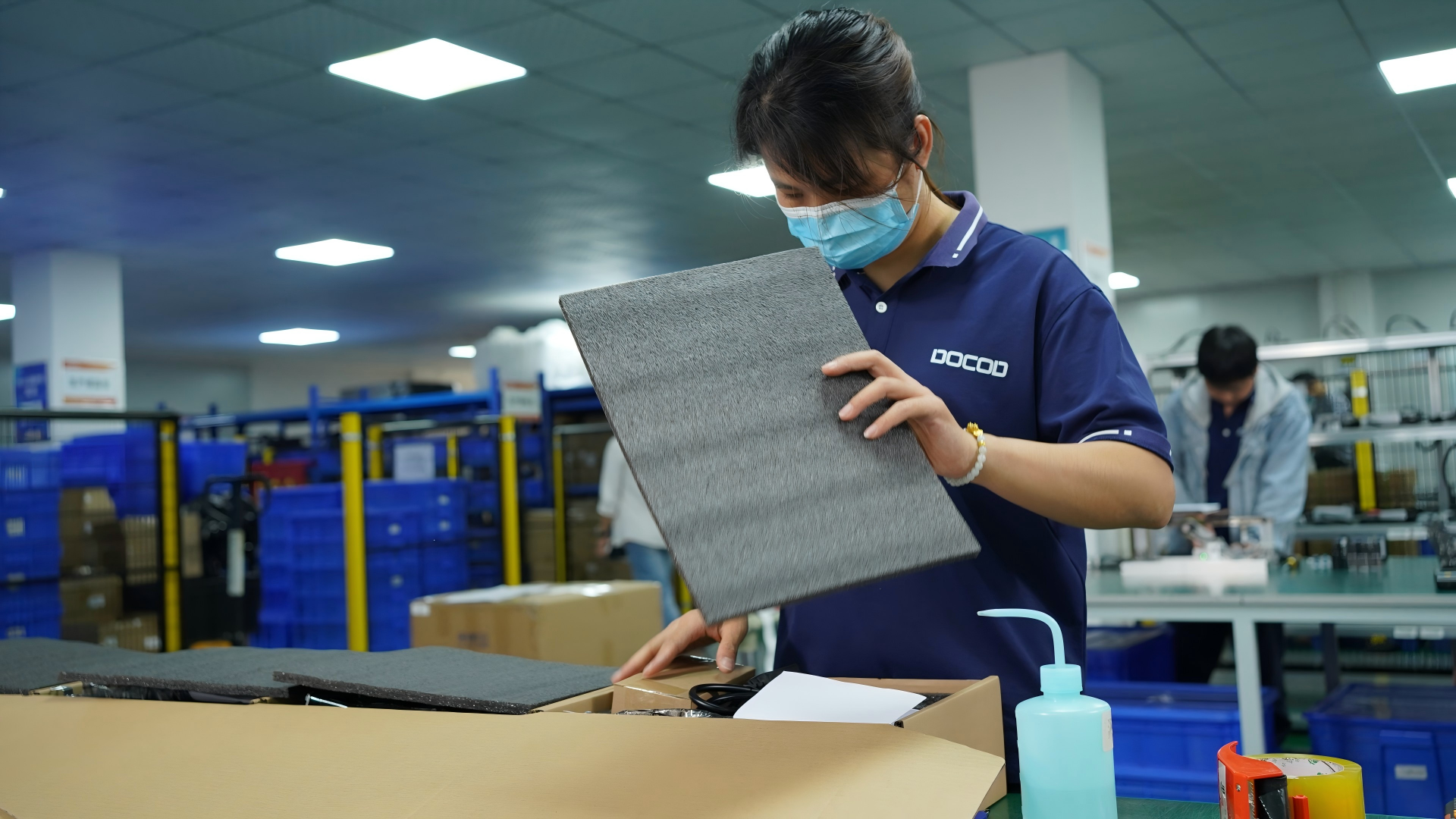
Send us your substrate sample and the code content you need for a configuration recommendation, a sample print trial or a quotation. Standard equipment is typically delivered within 15 working days.
Email: sales@docod.com.cn · WhatsApp: +86 135-1234-4323 · Website: www.docod-group.com
Have Questions or Need More Details?
Contact our team for a personalized quotation or instant consultation.
Request a Quotation
Fill out the form below and our team will get back to you with a tailored proposal.
WhatsApp Direct Chat
Prefer to chat in real-time? Message us on WhatsApp for instant assistance & quick answers.
- Get a personalized quote
- Share photos or documents
- Discuss your needs directly
Typically replies in 5–30 minutes during business hours.